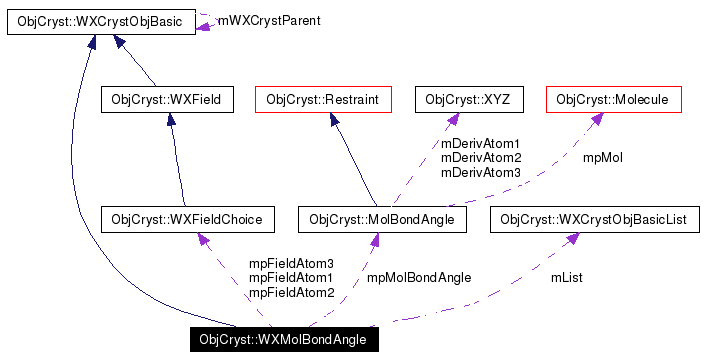
Collaboration diagram for ObjCryst::RefParType:
Public Member Functions | |
| RefParType (const string &name) | |
| Create a top parameter type. | |
| RefParType (const RefParType *parent, const string &name) | |
| create a children type. | |
| ~RefParType () | |
| Destructor. | |
| bool | IsDescendantFromOrSameAs (const RefParType *type) const |
| Returns true if the parameter is a descendant of 'type'. | |
| bool | operator== (const RefParType *parent) const |
| returns true if the two types are the same. | |
| const string & | GetName () const |
| Get the name for this parameter. | |
Private Member Functions | |
| void | InitId () |
| Get a Unique id (RefParType::mId). | |
Private Attributes | |
| const RefParType * | mpParent |
| the parent for this RefParType (we could easily allow several...) | |
| const string | mName |
| The name/description for this parameter type. | |
| unsigned long | mId |
| The unique number identifying this type. | |
This is used to categorize all parameters, to be able to modify a complete category of parameters (fix/unfix, set limits,...). The types are organized as a tree.
Parameters should be allocated globally in the heap, so we only use pointers in the interface.
|
|
Create a top parameter type. (in ObjCryst, there is only one, the "ObjCryst" category. |
|
||||||||||||
|
create a children type.
|
|
|
Destructor.
|
|
|
Get the name for this parameter.
|
|
|
Get a Unique id (RefParType::mId).
|
|
|
Returns true if the parameter is a descendant of 'type'.
|
|
|
returns true if the two types are the same.
|
|
|
The unique number identifying this type.
|
|
|
The name/description for this parameter type.
|
|
|
the parent for this RefParType (we could easily allow several...)
|
 1.3.6
1.3.6